What a Slovak invoice must contain
Two different lists apply, depending on whether you are registered for VAT — and using the wrong one is the mistake that costs money. Below is each list in full, the wording that is mandatory in specific cases, what does not have to be on the invoice at all, and what actually happens when a detail is missing.
Updated:
Which rules apply to you
If you are registered for VAT, your invoice is governed by §74(1) of Act 222/2004 on VAT. If you are not, that paragraph does not apply to you at all: your invoice is an accounting document under §10 of Act 431/2002 on accounting, and the identification on it comes from §3a of the Commercial Code. Both lists end with the same document, but they do not contain the same details.
Mandatory details of a VAT payer’s invoice
§74(1) of Act 222/2004 on VAT. An invoice may carry more than the law asks; it may not carry less, and no mandatory detail may be shortened or cut off to fit the layout.
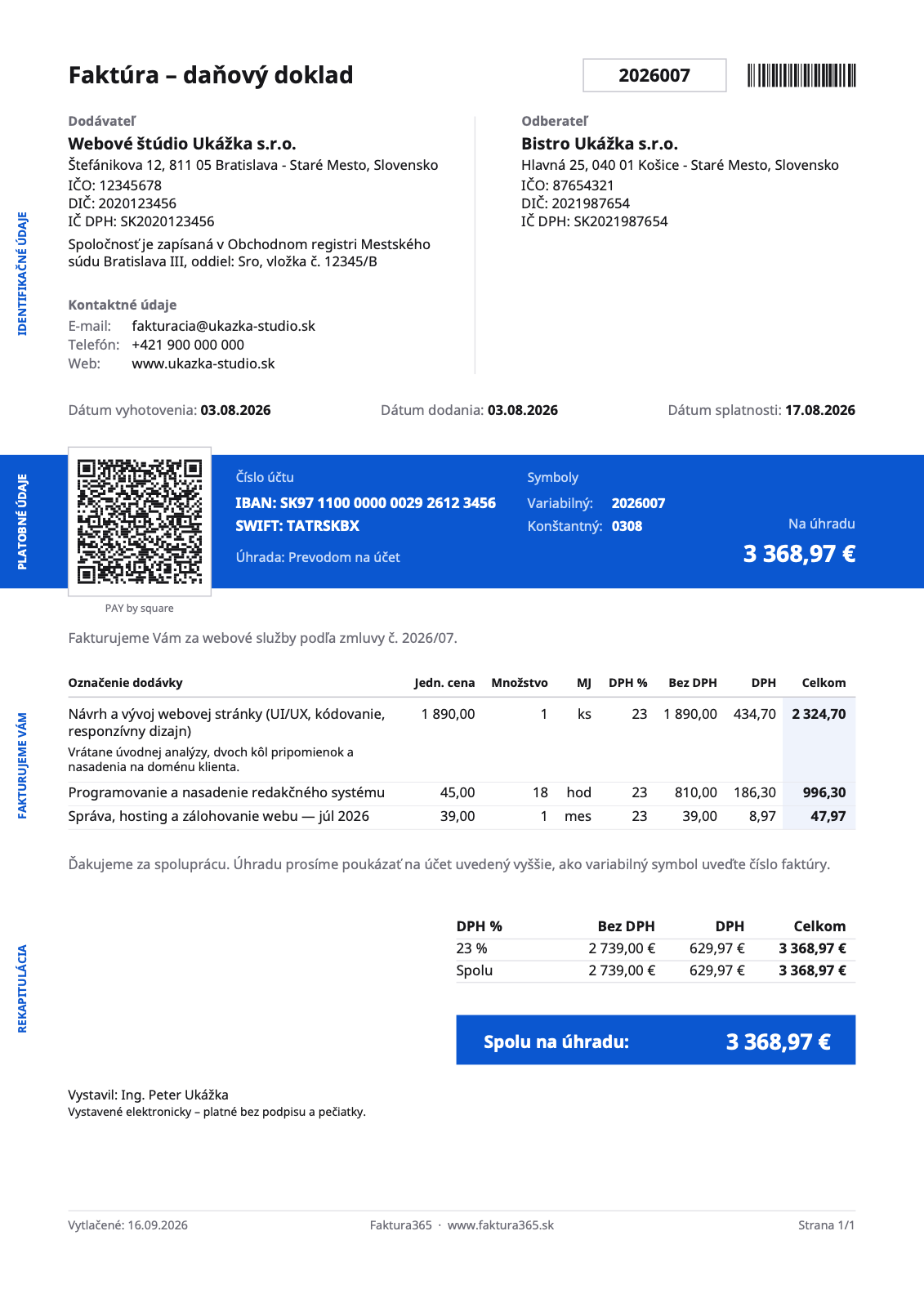
- Supplier
- Customer
- Sequential number
- Date of supply
- Date of issue
- Description and quantity
- Tax base and unit price
- VAT rate
- Amount of tax
- Mandatory wordingIt is not on the sample: it is required only for an exempt supply, a reverse charge or a margin scheme — and this one is an ordinary supply at 23 % VAT.
- Supplier
- Name or business name, the address of the registered office or place of business, and IČ DPH — as they are entered in the register, not a delivery address.
- Customer
- Name, address and their IČ DPH. Where the customer is not registered for VAT, their IČO and DIČ.
- Sequential number
- Unique within your series. Two documents sharing a number, or a gap left by deleting an issued invoice, is the first thing an audit looks at — the numbering is what makes the set auditable.
- Date of supply
- The day the goods or the service were actually delivered, or the day payment was received if that came first. It is a separate detail from the issue date and it decides the tax period; repeating the issue date here is the most common defect.
- Date of issue
- The day the invoice itself was drawn up.
- Description and quantity
- The quantity and type of the goods, or the scope and type of the service — specific enough to identify what was supplied. “Services under the contract” is not a description, and it is the customer’s deduction that suffers for it.
- Tax base and unit price
- The tax base for each rate separately, the unit price excluding tax, and any discount that is not already included in it.
- VAT rate
- The rate applied — in 2026 that is 23 %, 19 % or 5 % — or, where no Slovak tax is charged, the ground for it. A bare “0 %” with no ground is a defective invoice.
- Amount of tax
- In euros, always. An invoice issued in another currency still states the tax in euros, converted at the reference rate for the day the tax duty arose (§26).
- Mandatory wording
- The exact phrase the situation calls for — the cases are listed below.
What a non-VAT payer shows instead
§10 of Act 431/2002 on accounting, plus §3a of the Commercial Code for the identification.
- Name and number of the document
- It has to identify itself as an invoice and carry a number from a continuous series.
- Both parties
- Business name, registered office or place of business, IČO, and DIČ if one has been assigned.
- Register entry
- The commercial register with the section and insert (oddiel, vložka), or the trade register with its number. This is the detail templates leave out most often, and §3a makes it mandatory on every business document — not only on invoices.
- Subject and quantity
- What was supplied and how much of it.
- Amount
- The price, with no tax rate and no tax amount anywhere on the document.
- Dates
- The date the document was issued and the date the transaction took place.
- The person responsible
- A signature or another marker of the person who drew the document up; an invoice issued from a system carries it as the issuer’s identification.
A non-VAT payer’s invoice must NOT show IČ DPH, a VAT rate, a “0 % VAT” line or any tax amount. Tax you print is tax you owe: §69(5) of the VAT Act makes the amount payable because it is on the document, even though you are not registered. The customary line is “Nie som platiteľ DPH.”
Wording that is mandatory in specific cases
§74(1)(j) and §69(12). Without it the reader cannot tell an exempt supply from a reverse charge from a mistake — which is why a bare zero rate is not enough.
- Domestic reverse charge (§69(12))
- “prenesenie daňovej povinnosti”
- Service to a taxable person abroad (§15(1))
- “prenesenie daňovej povinnosti”
- Goods to another EU member state (§43)
- “oslobodené od dane” together with the reference to §43
- Export outside the EU (§47)
- “oslobodené od dane” together with the reference to §47
- Any other exempt supply (§28–§42)
- “oslobodené od dane” together with the exact provision it rests on
- The customer issues the invoice
- “vyhotovenie faktúry odberateľom”
- Margin scheme
- “úprava zdaňovania prirážky — cestovné kancelárie”, or “— použitý tovar” for second-hand goods
What does not have to be on the invoice
Every item below is asked for by somebody at least once a year. None of them is a mandatory detail.
- A signature and a stamp. Neither appears in §74(1); an invoice is valid without both, and a scanned signature adds nothing legally.
- A bank account or an IBAN. It is not among the mandatory details — it belongs on the document when the invoice is actually settled by transfer, and requiring one for a cash, card or offset payment refuses a perfectly legal document.
- A logo, colours, or a Pay by square QR code. Useful, never required: the QR only saves the payer from typing the account number.
- A due date. It follows from your contract, not from the VAT Act. The 15-day rule below is about ISSUING the invoice, not about paying it.
What happens when a detail is missing
- Your customer pays for it first
- A missing or unidentifiable detail is what a tax office challenges when it disallows the input VAT — which is why a business customer sends the invoice back instead of paying it.
- You cannot fix it by editing the invoice
- An issued document is never changed or deleted. A correction is a SECOND document — an opravná faktúra referencing the original’s number (§71(2)): a dobropis when it lowers the amount, a ťarchopis when it raises it.
- Tax you print is tax you owe
- A rate or an amount of tax on the document of someone who is not registered for VAT becomes payable under §69(5). This is the one mistake on this page that creates a debt on its own.
- Penalties
- The general regime is §154–§155 of the Tax Code (Act 563/2009). For the e-invoicing duties that start in 2027 the announced sanctions reach €10,000, and €100,000 for repeated breaches (Act 385/2025).
- It does not age out
- The invoice is kept for ten years, legible and unchanged (§76 of the VAT Act, §35 of the accounting act) — long enough for the mistake to be found.
When the invoice has to be issued
§73 gives you 15 days from the day the supply was made, or from the day payment was received if that came first. For goods exempt under §43 and for services to another member state where the customer owes the tax, the deadline is 15 days from the END of the calendar month. A summary invoice (§75) may cover at most one calendar month.
Frequently asked questions
Does an invoice need a signature and a stamp?
No. Neither is a mandatory detail under §74(1), and an invoice without them is valid. A non-VAT payer’s accounting document does need the responsible person identified, which the issuer’s details on the document satisfy.
Can I still send invoices as a PDF by email?
Yes, today: an electronic invoice is equivalent to a paper one as long as the customer agrees to that form and the content stays unchanged. From 1 January 2027, however, domestic B2B invoices between VAT payers must be issued in a structured electronic format under Act 385/2025 — a PDF will no longer be enough for those.
I have already sent an invoice with a detail missing. What now?
Issue an opravná faktúra that references the original invoice’s number and shows the corrected data (§71(2)). Do not edit or delete the original — it is an accounting document, and deleting it also punches a hole in your numbering.
Does my register entry really have to be on the invoice?
Yes. §3a of the Commercial Code requires the business name, the registered office, IČO and the register entry — the commercial register with the section and insert, or the trade register with its number — on every business document, invoices included.
What is a simplified invoice?
A document that may omit the customer’s data and the unit price without tax (§74(3)): an eKasa receipt or a fuel-pump receipt up to €400 including VAT (the limit since 1 January 2025), and any other document up to €100 including VAT. It may not be used for supplies exempt under §43, nor where the place of supply is abroad and the customer owes the tax.
Let the form hold the checklist
Faktura365 puts every mandatory detail on the document, keeps the numbering continuous and prints the wording a zero-rated line needs — for VAT payers and non-payers alike.
Open the appSources
This information is general in nature and does not replace tax or legal advice. Thresholds and duties change — check your own situation with an accountant.