Correcting an invoice: opravná faktúra and dobropis
The invoice went out with the wrong amount, the customer returned half the order, or you agreed a discount after the fact. In every one of those cases the fix is the same: not a rewrite, but a second document. Here is which one, what belongs on it, by when, and — the part that costs money — which tax period each side puts it in.
Updated:
An issued invoice is never rewritten
Once an invoice has been issued it is an accounting document: it is kept for ten years, it may not be erased, and its number is part of a sequence that has to stay unbroken. That is why every correction in Slovak invoicing is a SECOND document referring to the first, and why deleting the wrong invoice and issuing a “clean” one is the worst available option — it removes a number from the series and leaves your customer holding a document you say does not exist.
A corrective document is any document that changes the original invoice and refers to it specifically and unambiguously (§71(2) of the VAT Act). It does not have to be called an invoice — but it does have to name the original invoice’s number and show what changed.
Dobropis, ťarchopis, storno — which is which
- Dobropis
- A correction downwards: the supply was cancelled or returned, or the price fell after the tax duty arose. The amounts carry a minus.
- Ťarchopis
- A correction upwards: the price rose after the supply. The same document type, the other direction.
- Storno
- Voiding a document that should never have existed at all — a duplicate, an invoice issued to the wrong customer. It is not a correction of the tax base in the VAT sense, and it does not free the number to be used again.
- A wrong detail, not a wrong amount
- A misspelt name or address changes no tax base, so §25 does not apply. It is still corrected with a document that identifies the original and states the corrected data — never by editing the original, which the Accounting Act forbids.
When the tax base gets corrected
The four cases of §25(1) of the VAT Act. Anything else is not a §25 correction.
- The supply was cancelled
- In full or in part — the job did not happen, or part of it did not.
- The goods came back
- A full or partial return of what was delivered.
- The price went down
- A discount, a rebate or a settlement agreed after the tax duty had already arisen.
- The price went up
- The one case that produces a ťarchopis rather than a dobropis.
What has to be on the corrective document
A corrective document does not repeat the whole invoice. §71(2) asks for the link and the delta — the four things below.
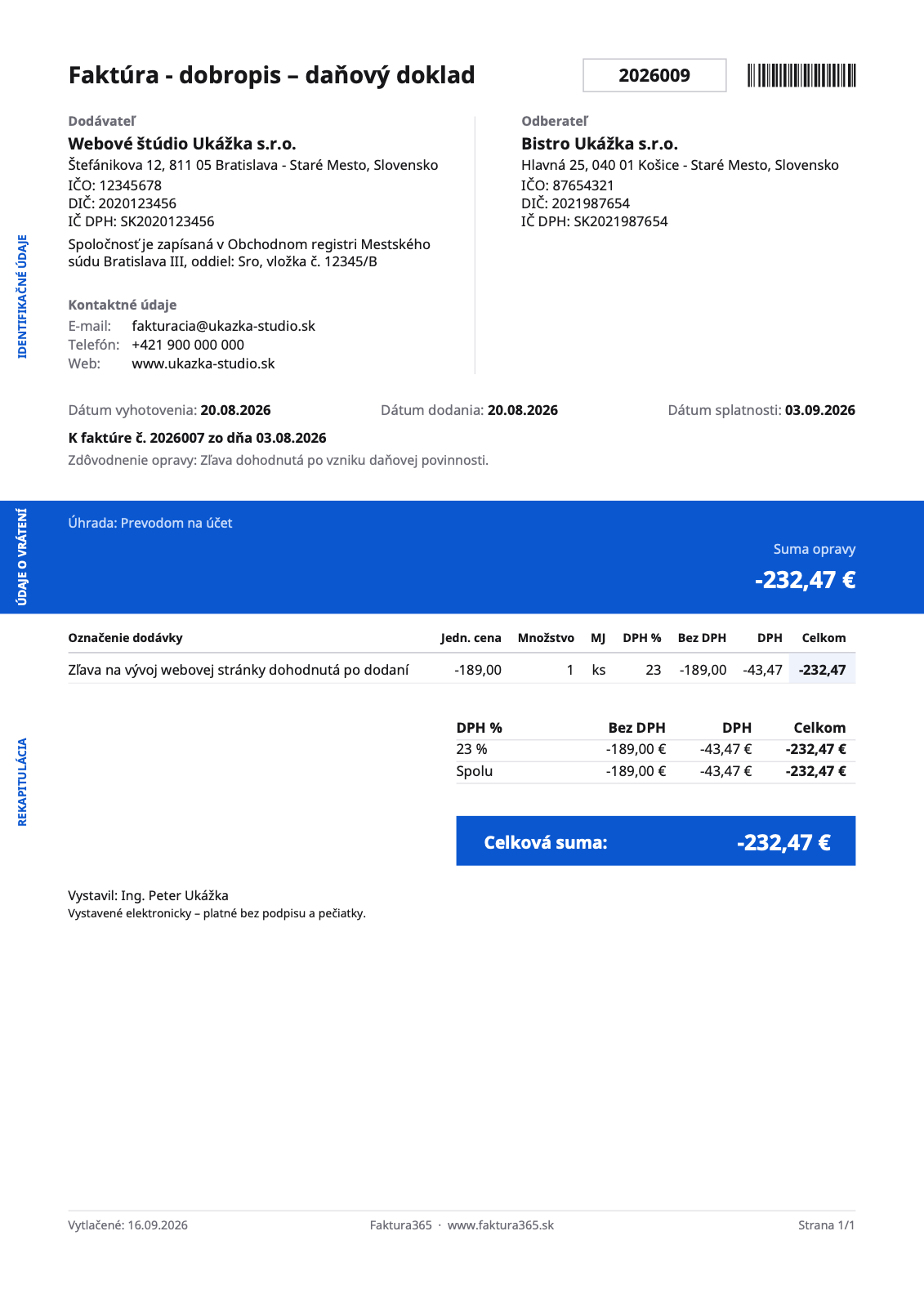
- A name that says it is a correction
- The number of the original invoice
- Only the data that changed
- The rate that applied to the original
- A name that says it is a correction
- “Opravná faktúra”, “Dobropis” or “Ťarchopis” — not “Faktúra”. Everyone downstream sorts the document by this word.
- The number of the original invoice
- The reference that ties the two documents together. Without it the correction relates to nothing and cannot be matched by either accountant.
- Only the data that changed
- The corrected base and tax, or the corrected detail. The unchanged lines do not have to be repeated.
- The rate that applied to the original
- Not today’s rate — see below. A correction is dated now but belongs to the supply that was taxed then.
The deadline, and the two different tax periods
The document is issued within 15 days of the end of the calendar month in which the decisive fact occurred — the cancellation, the return, the agreed discount (§73). Then the two sides part ways, and this is the detail worth remembering: you, the supplier, report the difference in the period in which you ISSUED the corrective document. Your customer corrects their deduction in the period in which they RECEIVED it. Post a dobropis on the 30th of the month and the two of you will be declaring the same correction in different periods — which is exactly what the tax office sees.
- Deadline to issue
- 15 days from the end of the calendar month in which the fact decisive for the correction occurred (§73).
- The supplier declares it
- In the period in which the corrective document was issued.
- The customer declares it
- In the period in which they received it (§53). Which is why sending it late is not a neutral act.
The rate on a correction is the ORIGINAL rate
A correction follows the supply it corrects, not the calendar. An invoice issued in 2024 carried the 20 % base rate; the dobropis you write for it today still uses 20 %, even though the base rate has been 23 % since 1 January 2025. Applying the current rate to an old supply changes the amount of tax being given back and makes the two documents disagree — which is what an inspection compares.
If you are not registered for VAT
There is no tax base to correct, so §25 does not concern you. Everything else still does: the original stays untouched, the correction is a second document that names the original’s number and shows the corrected amount, and neither document carries a rate or an amount of tax. In practice you write the same dobropis — it simply has no VAT lines.
Where this goes wrong
- Deleting the invoice and issuing a new one
- The fastest way to a hole in the numbering and to two versions of one transaction in circulation. An issued document is kept for ten years whether it was right or not.
- The correction does not name the original
- Then it is not a corrective document under §71(2) — it is an unexplained credit that neither accountant can attach to anything.
- Today’s rate on an old supply
- A 2024 invoice corrected at 23 % gives back more tax than was ever paid on it. The rate belongs to the original supply.
- Assuming both sides declare it together
- They do not: issued for you, received for them. A correction sent at the end of a month routinely straddles two periods, and that is normal — as long as each side uses its own rule.
- Using a minus quantity instead of a minus price
- A quantity is what was delivered, and “minus one piece” never was. A correction gives money back through a negative unit price; the quantity stays positive on every document.
Frequently asked questions
The customer has not paid yet. Can I just cancel the invoice?
Not by deleting it. If the supply is off, the correction is a dobropis for the full amount referring to the original number; the pair then nets to zero and the sequence stays intact.
Does the corrective document need the customer’s signature?
No. What matters is that it reaches them — their side of the correction runs from the day they receive it, so send it in a way you can evidence.
Can one dobropis correct several invoices?
It has to relate to the original invoices specifically and unambiguously, so each original number must appear on it. One document listing three invoice numbers and the change to each satisfies that; a lump sum with no references does not.
What if the mistake is only in the address or the company name?
That is not a correction of the tax base, so §25 and its deadline do not apply. You still issue a document that identifies the original invoice and states the corrected data — the original itself is never overwritten.
Can the total on a document be negative?
On a credit note, yes — that is exactly what it is for. On an ordinary invoice, no: a rebate line may be negative, but the document as a whole may not total below zero unless it is a correction.
Issue the correction as a document, not as an edit
Faktura365 issues an opravná faktúra that quotes the original invoice’s number, keeps the numbering continuous and prints the negative amounts the way a Slovak accountant expects them.
Open the appSources
This information is general in nature and does not replace tax or legal advice. Thresholds and duties change — check your own situation with an accountant.