Invoice without VAT: what a non-payer has to put on it
Most živnostníci start out as non-payers of VAT, and their invoice is genuinely simpler: no tax base, no rate, no VAT amount. What it still has to identify, what belongs in place of the VAT line, and when the exemption ends — below.
Updated:
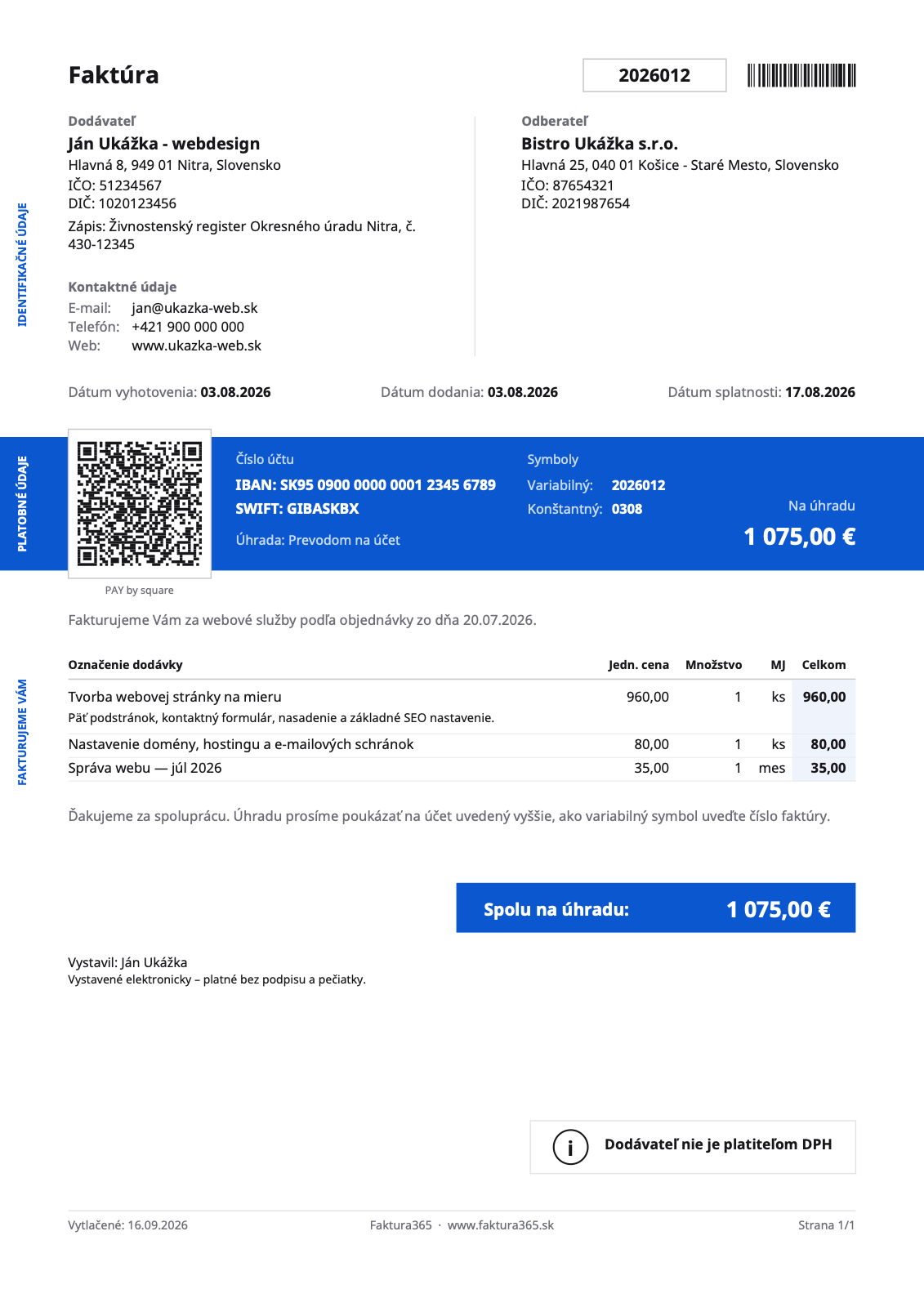
What the invoice must contain
A non-payer does not invoice under §74 of the VAT Act. The invoice is an ordinary accounting document, and it identifies both sides under the Commercial Code.
- You, the supplier
- Business name, registered office or place of business, and IČO.
- Your register
- Which register you are entered in — the trade register for a živnosť, the commercial register for an s.r.o. — with the entry number.
- The customer
- Name, address and IČO. If they are a VAT payer, their IČ DPH belongs there too.
- Sequential number
- From one continuous series that does not repeat.
- Dates
- The date of issue, and the date of supply when it differs from it.
- What you supplied
- The description and quantity of the goods, or the scope of the service.
- The price
- A single amount. Without a tax base, a rate or a VAT figure — you are not charging any.
- How to pay
- IBAN, the variable symbol and the due date. Not required by law, but an invoice without them gets paid late.
What goes in place of the VAT line
Nothing is required by law, but leaving it unsaid invites a phone call from the customer's accountant, who is looking for the tax they cannot deduct. One line settles it.
Nie som platiteľom DPH. — write it exactly like that, in Slovak, even on an invoice otherwise in English.
When you stop being a non-payer
Turnover is counted per CALENDAR year — not per rolling twelve months, as it used to be.
- Turnover over 50 000 €
- You become a VAT payer on 1 January of the following year, and you have five working days from crossing the threshold to file the registration application.
- Turnover over 62 500 €
- You become a VAT payer on the day of the supply that crossed it — not next year. From that supply on, you invoice with VAT.
Watch the figure yourself
Nobody warns you. The tax office does not track your turnover for you, and crossing the threshold unnoticed means invoices issued without VAT that should have carried it. Keep the running total where you can see it — that is one of the reasons this app adds your invoices up for you.
Frequently asked questions
Do I need an IČ DPH as a non-payer?
No. You have an IČO, and a DIČ once you are registered for income tax. IČ DPH is only issued on VAT registration — leave the field off the invoice entirely.
Can I invoice a foreign customer as a non-payer?
Yes, but a supply of services to a business in another EU country usually requires registration under §7a first. That registration does not make you a VAT payer on your domestic invoices — it is a different status.
I buy Google or Meta ads. Does that concern me?
Yes, and it is the half people miss. RECEIVING a service from a business in another EU country also triggers registration under §7a — ads, hosting and software subscriptions all count. You still do not become a VAT payer, but you owe the tax on that purchase and you cannot deduct it.
Does my customer mind that there is no VAT?
A VAT payer cannot deduct anything from your invoice, so your price is a final cost for them. It is worth knowing when you negotiate, but it is not a defect in the invoice.
Do I have to register the moment I cross 50 000 €?
You file the application within five working days of crossing, but you become a payer only on 1 January of the following year. Above 62 500 € it happens immediately, on the day of that supply.
Issue an invoice without VAT
Faktura365 knows you are a non-payer, leaves the VAT columns out and adds the clause for you.
Open the appSources
This information is general in nature and does not replace tax or legal advice. Thresholds and duties change — check your own situation with an accountant.