Invoice template: what it must contain
An invoice is not just a list of items — the law sets out exactly what has to be on it. Below are the mandatory details for sole traders and companies in Slovakia, separately for VAT payers and non-payers.
Updated:
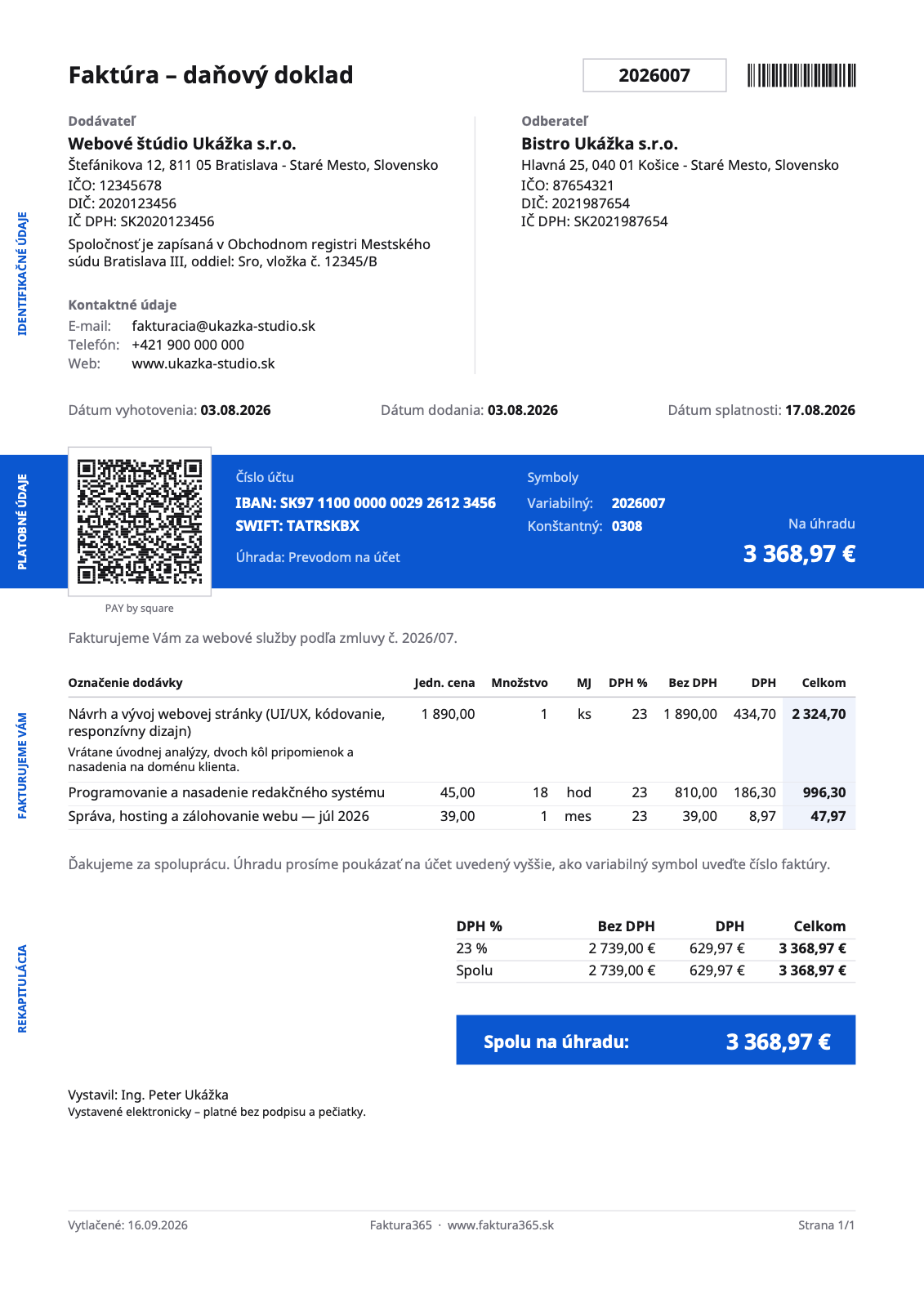
Mandatory details of a VAT payer invoice
Set out in §74(1) of the Slovak VAT Act.
- Supplier
- Name, address of the registered office or place of business, and VAT number (IČ DPH).
- Customer
- Name, address and their VAT number.
- Sequential invoice number
- The number series must be continuous and must not repeat.
- Date of supply
- The day the goods or services were delivered, if it differs from the issue date.
- Date of issue
- The day the invoice itself was drawn up.
- Description and quantity
- The quantity and type of goods, or the scope and type of the service.
- Tax base and unit price
- The tax base for each rate, the unit price excluding tax, and any discounts not included in it.
- VAT rate
- The rate applied, or a reference to the exemption from tax.
- VAT amount
- The amount of tax in euros.
- Wording where required
- For example “reverse charge” or “self-billing”, where those rules apply.
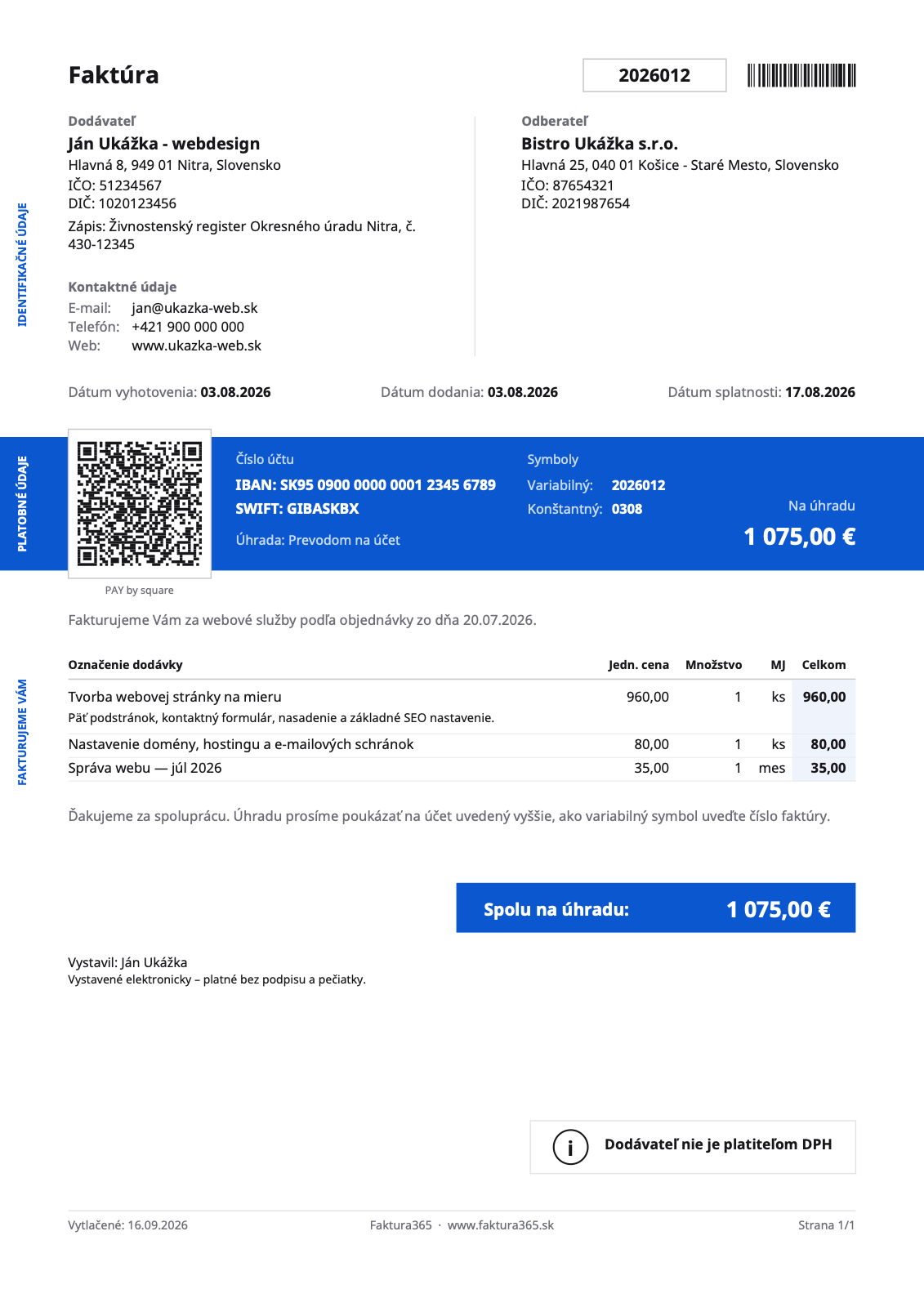
Invoice without VAT
If you are not a VAT payer, you do not state VAT on the invoice. The invoice is an ordinary accounting document and identifies both parties under the Commercial Code: business name, registered office or place of business, company ID (IČO), and the register you are entered in (trade or commercial register).
It is worth adding the note “Nie som platiteľ DPH” (I am not a VAT payer) — the customer then immediately sees that they cannot deduct the tax.
When the invoice must be issued
A VAT payer has 15 days from the date of supply of the goods or services to issue the invoice, or from the date the payment was received if it came first.
Frequently asked questions
Does an invoice have to be signed and stamped?
No. Neither a signature nor a stamp is among the mandatory details — the invoice is valid without them.
Can I send invoices as a PDF by email?
Yes. An electronic invoice is equivalent to a paper one; what matters is that the customer agrees to that form and that the content stays unchanged.
How long do invoices have to be kept?
Accounting documents are kept for ten years following the year they relate to.
Issue an invoice in a minute
Faktura365 fills in the mandatory details for you and keeps the numbering continuous.
Open the appSources
This information is general in nature and does not replace tax or legal advice.