How to issue and send an e-invoice
From 1 January 2027 VAT payers must, for domestic supplies to businesses and to the public sector, issue the invoice in a structured format and send it through a delivery service. Less changes for you than it sounds: you issue the document exactly as you do today; what changes is what happens to it after you press the button.
Updated:
What a structured e-invoice is
It is not a picture of a document but a file of data that the software on the other side reads and posts with no retyping (§85o(4)). That is why its fields are fixed and why it cannot be "sent in a nicer form" — either the data fits, or the file does not go through.
A PDF sent by email is not an e-invoice in the sense of the new rules, no matter how correct its contents are.
The route an invoice takes
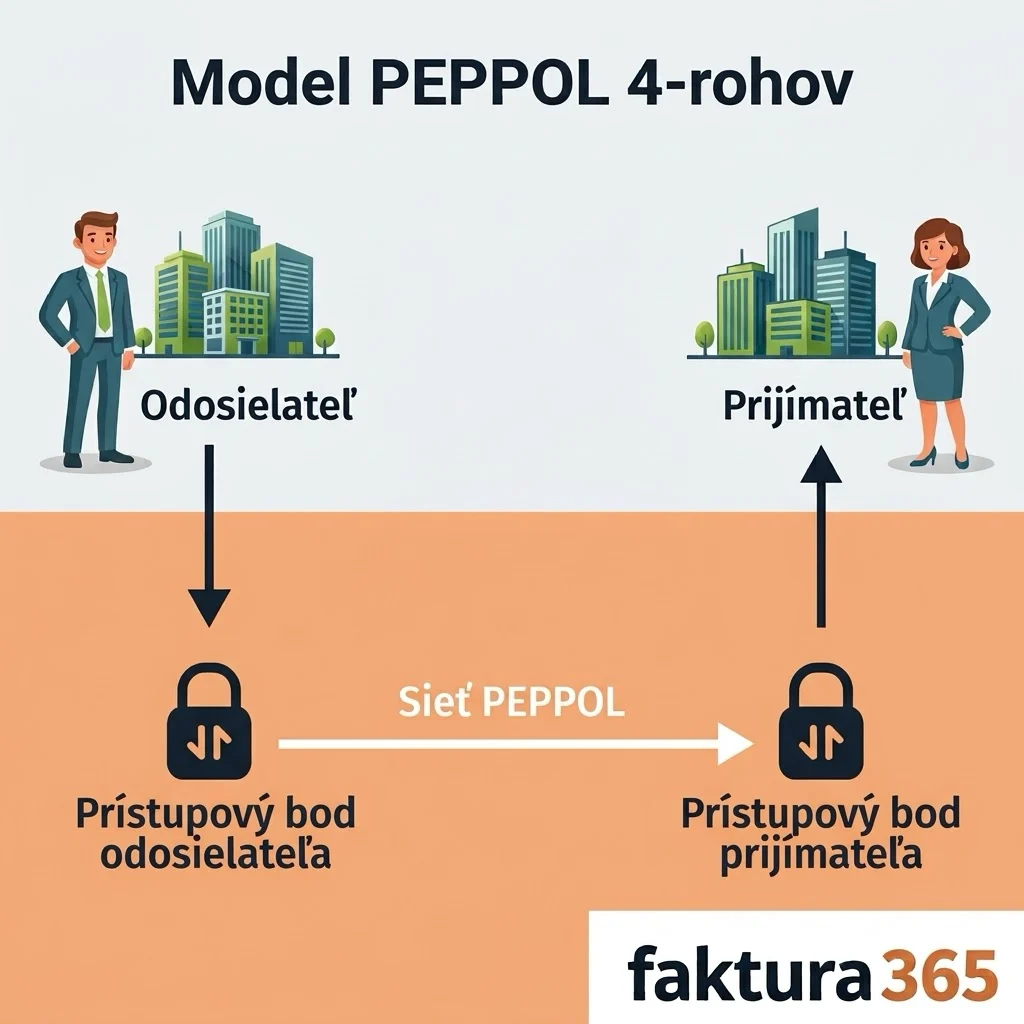
- 1. You issue the document
- In your own software, as you do today.
- 2. The software hands it to the provider
- To your certified delivery service provider. That hand-over also fulfils the reporting of the data to the tax administration (§85o(11)).
- 3. The provider sends it over the network
- To the customer's provider — Slovakia is building this on the Peppol network.
- 4. The customer gets it in their software
- As data it can post straight away.
You have 15 days to issue an e-invoice, counted from the supply or from receiving a payment in advance (§85o(6), the rule for 2027 to 2030). You do not need the customer's consent for it; you need it only if you want to send it some other way than through a delivery service (§85o(2)).
Who it applies to
VAT payers under §4, §4b and §4c, when from 1 January 2027 they supply goods or a service with the place of supply in Slovakia to a business established in Slovakia or to a legal person that is not a taxable person — typically an authority or a municipality (§85o(2) and (3) of the VAT Act).
It does not apply to invoices for private individuals, to simplified invoices under §74(3)(a) and (b), to exempt supplies, nor — for now — to non-payers of VAT, who only have to receive e-invoices.
What you need before the first one goes out
- A delivery service provider
- Without one the invoice does not get into the network. The register of certified providers is published by the Financial Directorate on its website (§76a(5)).
- The customer's DIČ
- An e-invoice is addressed by an identifier, not by a name — in Slovakia, the DIČ. A typo in it means an undelivered invoice.
- An unbroken number sequence
- The requirement does not change, but a skipped or duplicated number is visible at once with an e-invoice.
- A decision about the PDF
- The customer no longer needs it; you may still want it in your archive. The e-invoice itself is kept for 10 years (§85o(15)).
How it works in Faktura365
You send e-invoices in Faktura365 straight from an issued document. It works like this:
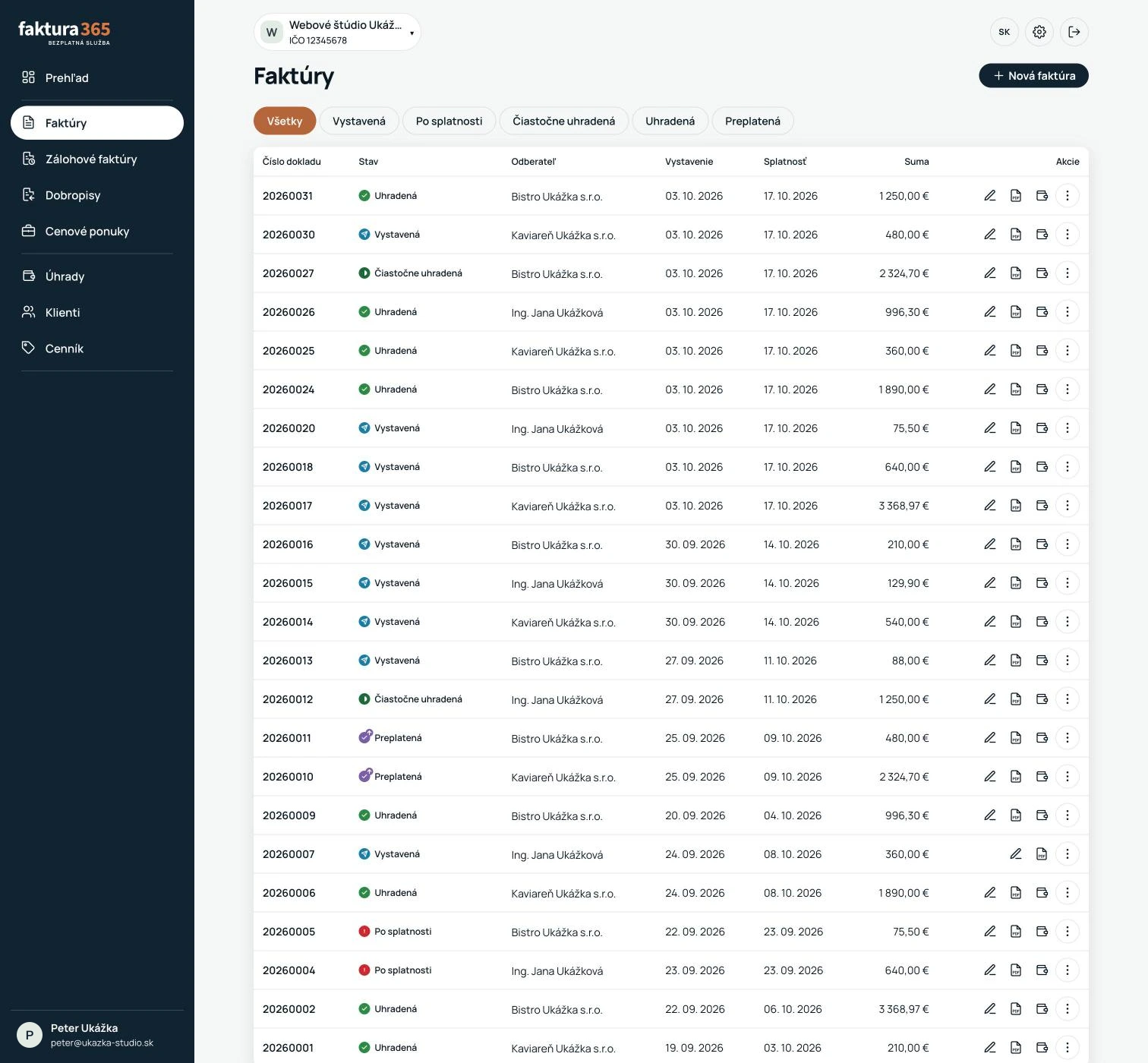
- 1. You issue the document as always
- An e-invoice has no form of its own. It is made from an invoice or a credit note you have already issued — from the stored amounts, with nothing recalculated.
- 2. In the document's menu you choose "Send" and then "E-invoice"
- The app shows the document number and the customer and reminds you that sending cannot be taken back.
- 3. The app checks whether the customer is in the network
- If they are not registered, nothing is sent and you learn it at once. If the customer's DIČ is missing from the document, the app says what to add.
- 4. You see the delivery status beside the document
- In the list of invoices the status reads "Sent as e-invoice", "E-invoice delivered" or "E-invoice not delivered". Once the invoice is paid, the status shows the payment instead.
- 5. A sent document is locked
- What it states can no longer be changed or deleted. A mistake is corrected with a credit note that refers to the number of the original invoice and travels the same way.
Receiving and sending e-invoices already work in Faktura365.
The most common mistakes
- A typo in the customer's DIČ
- On paper the addressee worked it out. In the network the invoice is not delivered — and if your software does not show the delivery status, you find out late.
- Correcting by rewriting the original document
- An issued document is neither changed nor deleted. A correction is a second document — a correcting invoice carrying the sequence number of the original; if the original went through a delivery service, the correction has to go that way too (§85o(5)).
- Relying on email
- A sent email is not a delivered e-invoice. What counts is the status from the delivery service.
Frequently asked questions
Can I still send a PDF after 2027?
For supplies covered by the obligation, a PDF does not replace the e-invoice. For an invoice to a private individual a PDF is enough — and you can always send one as an extra copy.
What if the customer is not in the network?
From 1 January 2027 every business established in Slovakia must be able to receive an e-invoice (§71(5) of the VAT Act). If they cannot be reached, the shortcoming is on their side — but meanwhile the invoice is not delivered, so it is worth checking in advance.
Do I have to change my invoice numbering?
No. The requirement of an unbroken number sequence does not change; a breach of it is simply more visible.
What is the fine?
For e-invoice data that is not reported, or reported late or incorrectly, up to €10,000, and up to €100,000 for a repeated breach (§85o(12) and (13), in force from 1 January 2027). No fine is imposed for an obvious error you have corrected or for a technical failure of the provider (§85o(14)).
Is it charged for?
Faktura365 is free at least until the end of 2027. If anything changes, we will write to you a month ahead.
Receive and send e-invoices in Faktura365
Open the appSources
This information is general in nature, reflects the state of the rules at the time of the last update, and does not replace tax or legal advice.