How to receive e-invoices from 2027
From 1 January 2027 you must be able to receive an e-invoice — even if you are not a VAT payer and do not have to issue one yourself. A mailbox is not enough: an e-invoice is a structured file that travels through a delivery service run by a certified provider. In practice it comes down to one decision — who you will receive invoices through — and one check, whether your suppliers can find you in the network.
Updated:
Why email and a PDF are not enough
An e-invoice is not a PDF attached to an email. It is a structured file — data that software reads and posts by itself, with no retyping (§85o(4)). And it does not go straight from your supplier to you: it passes through certified delivery service providers on both sides. That is why even the best-kept mailbox does not help.
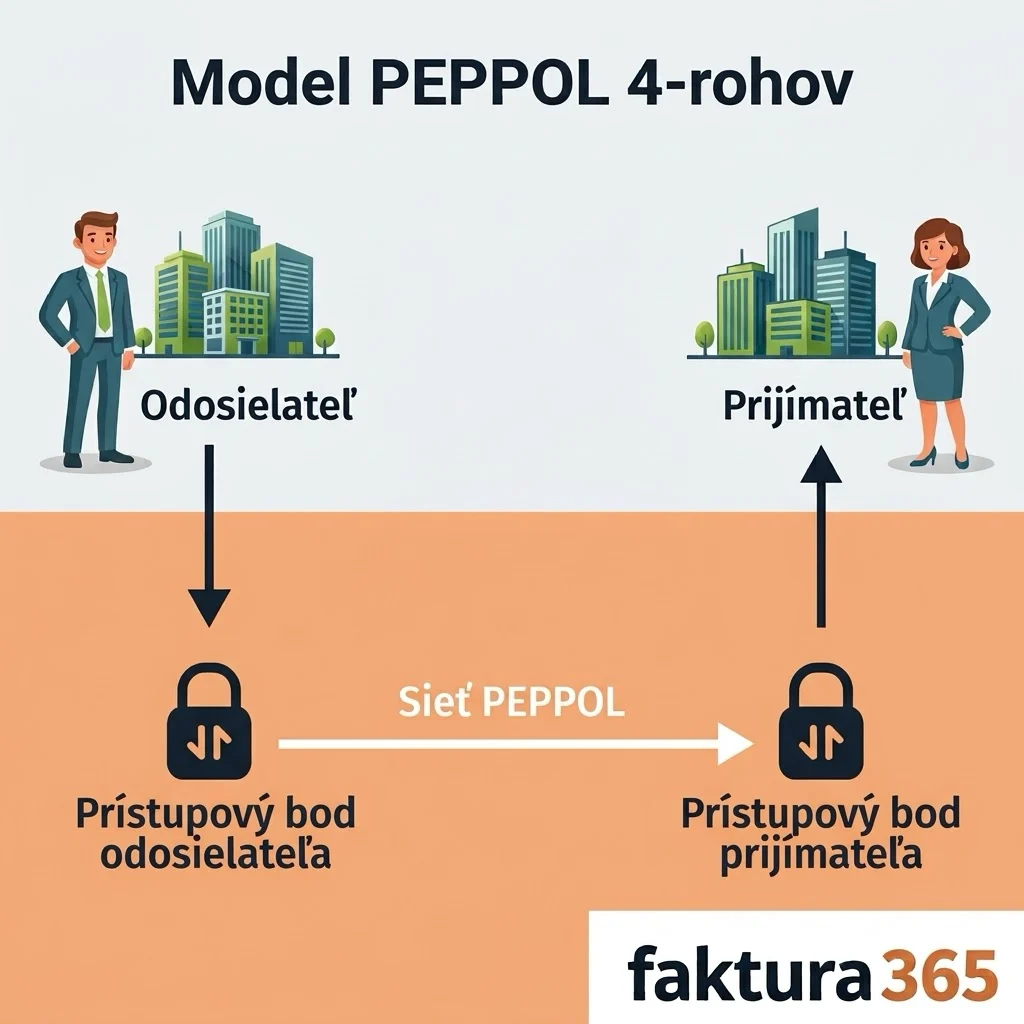
A supplier does not need your consent to issue an e-invoice (§85o(2)). Consent is needed only to send it some other way than through a delivery service — and even then it has to be a structured file, not a PDF.
Who has to be able to receive
Everyone a VAT payer must issue an e-invoice to has to be able to receive it (§71(5) of the VAT Act, in force from 1 January 2027): every business with its seat or place of business in Slovakia. That includes a živnostník on flat-rate expenses and a small s.r.o. that is not a VAT payer.
- VAT payer (§4, §4b, §4c)
- Issues and receives e-invoices from 1 January 2027.
- Non-payer of VAT — including one registered under §7 or §7a
- Does not have to issue them yet. Must be able to receive an e-invoice from 1 January 2027.
From 1 July 2030 the obligation to issue widens to further taxable persons and to cross-border supplies within the EU.
What you need for an e-invoice to reach you
- A delivery service provider
- The point where your invoices enter the network. Only someone entered in the register of certified providers can be one; the Financial Directorate keeps that register and publishes it on its website (§76a(5)). You rarely choose one separately — it is built into your invoicing or accounting software.
- Your DIČ
- An e-invoice is addressed by an identifier, not by a name or an email address. In Slovakia that identifier is the DIČ — not the IČ DPH, which a non-payer does not even have. Your supplier finds your business in the network by it; if they hold your DIČ with a typo, the invoice does not arrive.
- Tidy company details
- Your name, address and registration details should match the registers. On paper a person noticed the difference and fixed it; with an e-invoice a machine deals with it, and a machine fills in nothing.
How it works in Faktura365
Received e-invoices appear in Faktura365 under "Incoming invoices". It works like this:
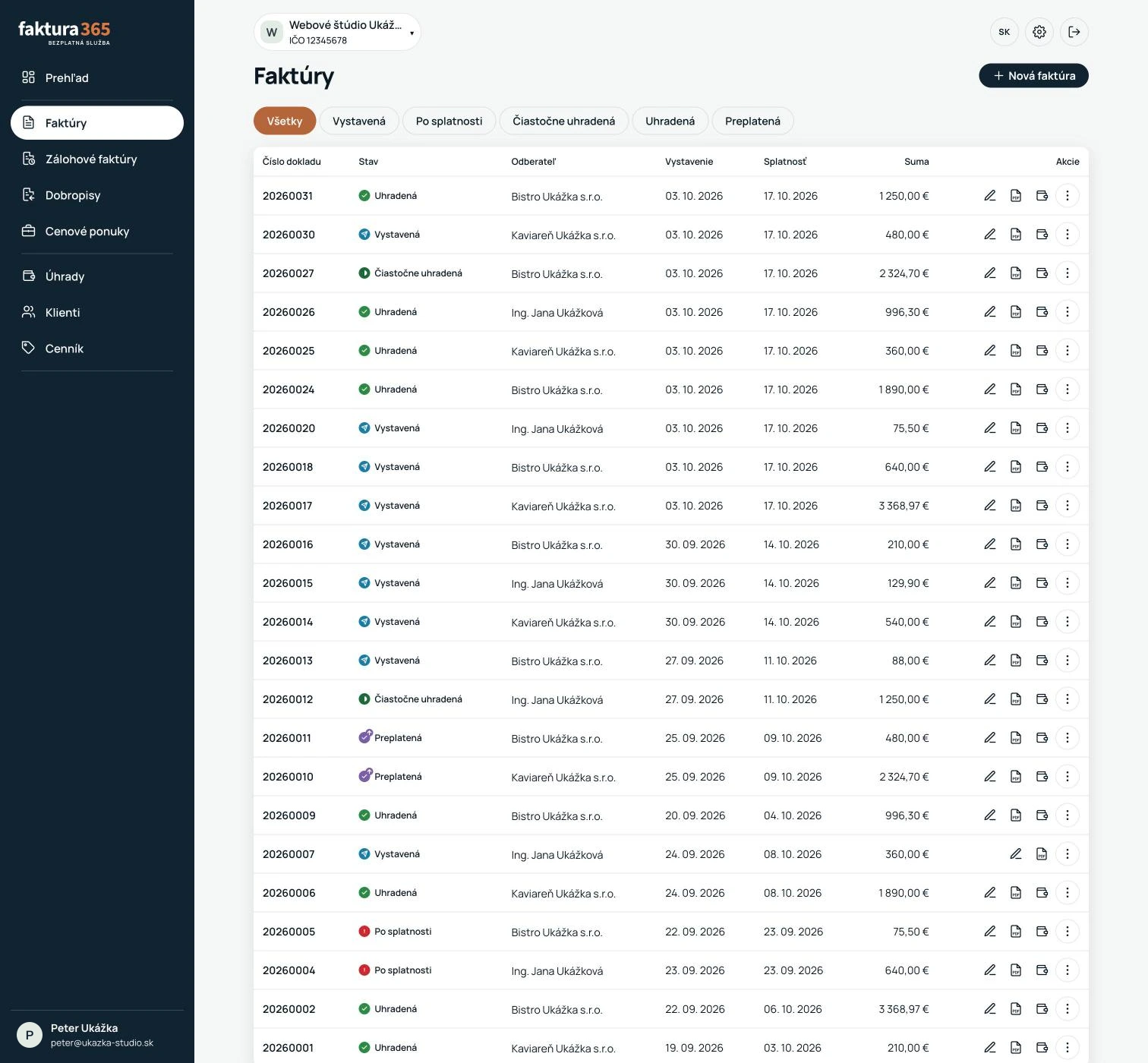
- 1. You connect your company once
- In the menu you open "E-invoice" and press "Connect". On the Financial Administration portal you then choose Efakturuj, our certified provider, as your digital postman and enter your company's e-mail and phone number, the same ones as on the company card. The registration in the Peppol network then runs by itself. Each company is connected separately.
- 2. Your address is made from your DIČ
- The company card must hold the DIČ, an e-mail and a phone number, and your own e-mail address must be confirmed. Without that the company cannot be connected.
- 3. Invoices appear in a list
- The document number, the supplier, the dates, the due date and the amount, exactly as the file states them. The supplier does not have to be among your partners beforehand.
- 4. You confirm or reject an invoice
- Confirming is your own note. A rejection is not passed on through the Peppol network: you can send the supplier an e-mail with the reason right from the app. A rejection does not cancel the invoice; the supplier corrects it with a credit note.
- 5. You open the document as a PDF or download the XML
- The XML file is the original; the PDF is only a readable rendering of it.
Receiving and sending e-invoices already work in Faktura365.
If you use other software
Ask your software vendor two things: whether it will be connected to a certified delivery service provider, and from when. If the answer is "we send PDFs by email", that will not meet the obligation from 2027.
And ask your accountant how they plan to process received e-invoices. If your two solutions diverge, it ends in retyping data by hand — exactly what the e-invoice is meant to remove.
What is worth doing today
- Check whether you are a VAT payer under §4 or only registered under §7 / §7a. That decides whether you will also have to issue e-invoices.
- Check your DIČ and address in the registers and in what you send to your suppliers.
- Agree with your accountant on the form in which they will want the received invoices from you.
- Do not buy anything in a hurry. The technical details are still being finalised and there is time before the deadline.
Frequently asked questions
Do I have to receive e-invoices if I am not a VAT payer?
Yes. You do not have to issue them yet, but from 1 January 2027 you must be able to receive an e-invoice from a supplier who is a VAT payer (§71(5) of the VAT Act).
Will an e-invoice arrive in my email?
No. It travels through a delivery service run by a certified provider. Your software shows it to you — but it has to be connected to such a provider.
What if a supplier still sends me a PDF after 2027?
For supplies covered by the obligation, a PDF is not an e-invoice. Outside it a PDF remains enough — for example on an invoice from a supplier who is not a VAT payer.
Do I have to register anywhere?
Your delivery service provider registers you in the network — once, after checking your identity and your company. The exact steps differ between providers; in Faktura365 they include a confirmation on the Financial Administration portal.
What will it cost me?
Faktura365 is free at least until the end of 2027. If anything changes, we will write to you a month ahead.
Receive and send e-invoices in Faktura365
Open the appSources
This information is general in nature, reflects the state of the rules at the time of the last update, and does not replace tax or legal advice.